Read the products of heating
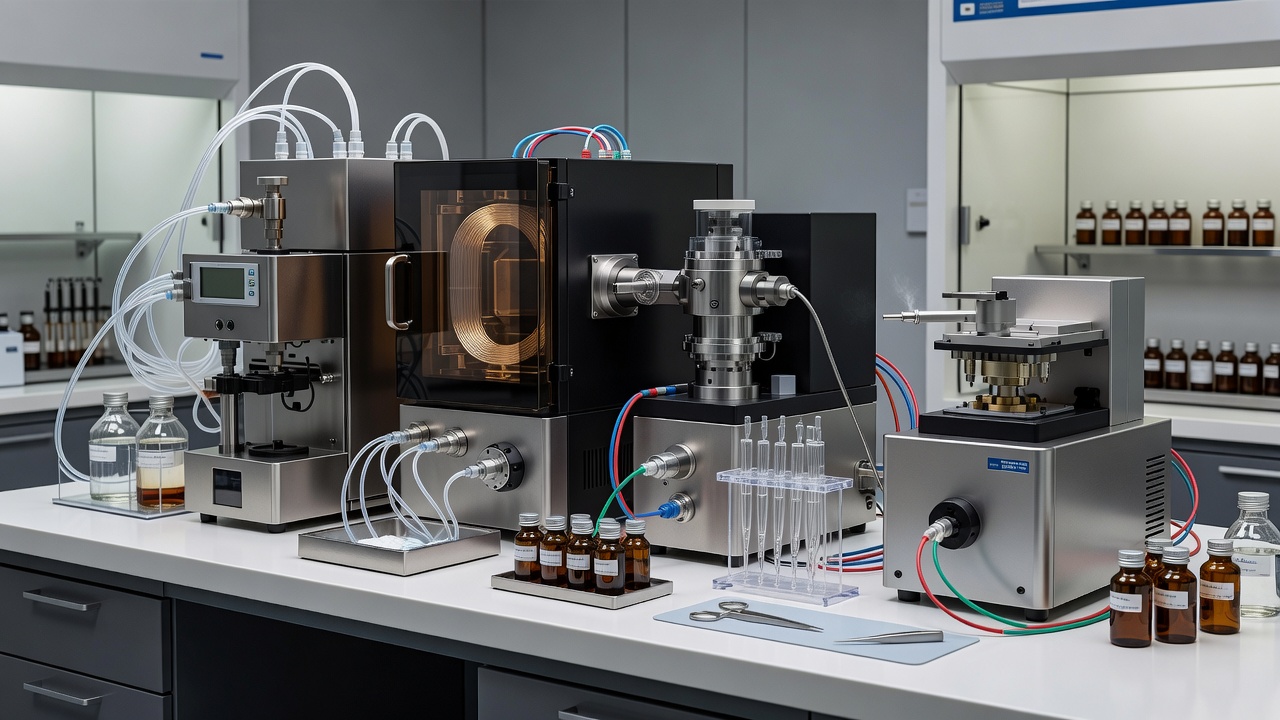
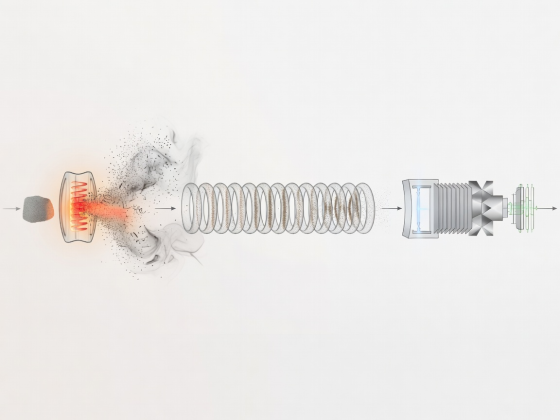
Thermoanalytical methods expose material to controlled temperature conditions and measure changes or released compounds. In pyrolysis–gas chromatography/mass spectrometry, abbreviated Py–GC/MS, heating breaks material into smaller products. Gas chromatography separates products, and mass spectrometry helps identify and measure selected signals.
With appropriate markers and calibration, those signals can support estimates of polymer mass in the analysed portion. The original particles are destroyed. Their individual dimensions, shapes and count cannot be recovered from the chromatogram alone. This trade-off is central to choosing the method.
Choose the measured quantity
A particle-based investigation may focus on abundance, morphology and size distribution. A thermal investigation may focus on the mass of selected polymers per sample mass or water volume. Neither quantity is inherently more meaningful; usefulness depends on the question. A few large fragments can dominate mass while many small particles dominate number.
For that reason, do not convert polymer mass to particle count without explicit assumptions about dimensions, shape and density. A spherical model may be mathematically convenient but environmentally unrealistic. If both measurements are needed, plan complementary analyses and preserve suitable material before a destructive step consumes it.
Check the marker’s specificity
A heating product may be associated with a target polymer without being exclusive to it under every condition. Natural organic matter, additives and other polymers can complicate the signal. Analysts use separation, diagnostic ions, retention behaviour and supporting markers to strengthen assignments and distinguish plausible interferences.
Instrument settings, temperature programmes and sample matrices affect the products observed. A marker validated in clean reference material still needs evaluation in the environmental matrix. Reporting only that a characteristic compound appeared leaves too much unstated: readers need the identification rules and evidence that competing sources were considered.
Make calibration part of the claim
Quantification requires a relationship between signal and known polymer amount. Calibration should span the relevant range and use suitable standards. Blank measurements reveal background, while checks at known levels help assess performance. An internal standard can support correction for some variability, but its usefulness depends on how well it represents the target’s behaviour.
State what was calibrated, the applicable range and the limits used for detection and quantification. A measured response outside a validated range should not become a precise-looking concentration through extrapolation alone. Preparation recovery, weighing, subsampling and instrumental variation all contribute to uncertainty, even when a calibration curve appears excellent.
Distinguish thermal approaches
Thermal extraction and desorption approaches, including TED–GC/MS workflows, can handle material differently from a small pyrolysis cup. Thermogravimetric analysis follows changes in mass during heating; coupling or collecting released products adds chemical information. Differential scanning calorimetry examines heat-flow behaviour and can support selected polymer investigations under appropriate conditions.
These techniques should not be grouped as if they produce identical evidence. Simple mass loss is rarely a unique polymer identification in a complex environmental mixture. Read the complete workflow: what entered the instrument, which compounds were captured, what was separated, and how target polymers were assigned and quantified.
Keep the analysed portion in view
Small analytical portions may not represent a heterogeneous environmental sample. A rare large fragment can change the measured mass substantially. Homogenisation and subsampling strategies therefore need documentation, and any preparation that removes or transforms material must be considered in the final interpretation.
A polymer-related signal also does not prove that the original material consisted only of particles inside a particular microplastic size interval. That claim depends on upstream isolation and size fractionation. Bulk material, coatings or other polymer-containing forms may contribute if the preparation allows them through.
The strongest report links the thermal result to its sampled fraction, calibration, blanks and recovery evidence. It explains why this method answers the research question and where particle-resolved spectroscopy would provide information that the thermal measurement cannot. See the thermal-analysis references for examples of that distinction in practice.