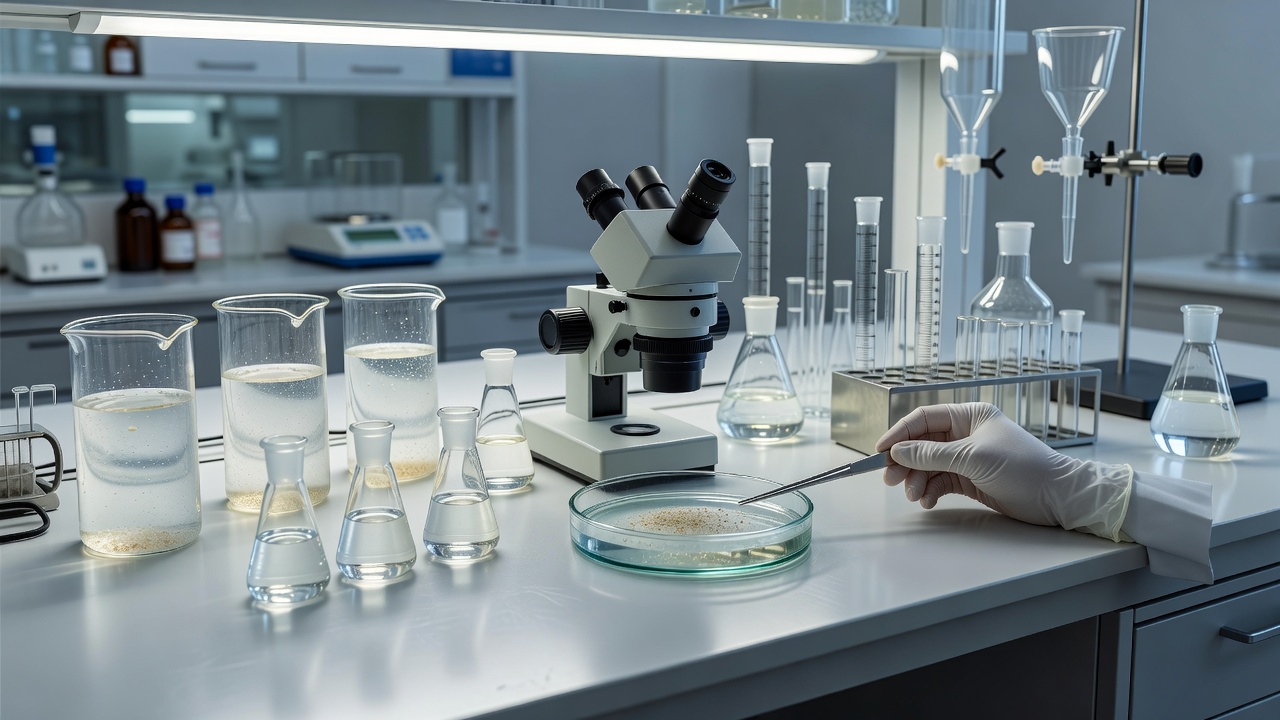
Define the sample before collecting it.
A microplastic result describes material recovered through a particular procedure. It does not automatically describe an entire river, beach or food product. A useful sampling plan begins with a precise question: particles in a known water volume, particles in a defined dry sediment mass, or polymer mass in a specified material.
Record the sampling location, depth, time, equipment and environmental conditions that matter to that question. A surface net samples a different fraction from a bottle collected below the surface. Replicates help describe variation; they do not erase a systematic bias in collection.
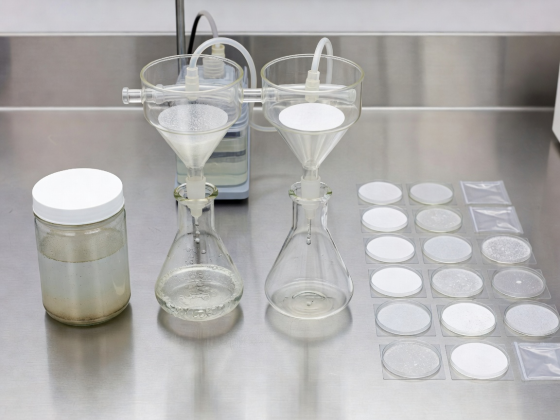
Specify the size window
Mesh openings, filters and analytical optics all impose selection. A net with a stated opening does not retain every particle with a nominal dimension above that value: fibres can align, particles can deform, and clogging changes flow. Record the actual collection and preparation conditions rather than treating the mesh label as a universal cutoff.
The final reporting window should reflect the whole workflow. Retaining a small particle is not the same as being able to locate and identify it. If the analysis excludes a lower size fraction, say so explicitly. Otherwise readers may mistake an operational count for all microplastics present.
Make contamination visible
Airborne fibres, equipment, reagents and packaging can introduce particles. Cover samples when practical, limit unnecessary transfers and use cleaned equipment compatible with the procedure. Glass and metal can reduce some plastic sources, but neither makes a workflow automatically contamination-free. Clothing and cleaning materials also deserve attention.
A field blank helps assess contamination associated with collection and transport. A procedural blank follows laboratory preparation without the environmental sample. An air-exposure control can reveal settling material under specified conditions. These controls answer different questions; a clean procedural blank cannot prove that field handling introduced nothing.
Prepare without assuming neutrality
Environmental samples contain minerals, organic matter and biological material that can obscure particles or overwhelm an instrument. Density separation concentrates materials according to buoyancy in a selected liquid. Low-density solutions may recover some common polymers while missing denser materials. Weathering, mineral coatings and aggregation further complicate that separation.
Digestion can reduce organic material, but treatment strength, temperature and duration can change susceptible polymers or alter their spectra. Choose conditions supported for the target matrix and materials. Record reagent composition and exposure rather than writing only “sample cleaned”. A preparation step that improves visibility may still change the population being counted.
Test recovery honestly
Spiking a known amount of reference material into a representative matrix can help estimate recovery. Use particle sizes, shapes and polymer types relevant to the intended measurement. Large, clean beads are convenient, but their behaviour may not represent small, weathered fibres or irregular fragments.
Introduce spikes early enough to test the stages you want to assess. A spike added immediately before instrumental analysis says little about losses during digestion or transfer. Report the recovery experiment alongside its limitations. A single recovery percentage should not be used as an unquestioned correction for every polymer and size class.
Preserve the chain of interpretation
Label containers clearly and maintain a handling log linking field identifiers, preparation batches, filters and instrument files. Note subsampling and any material left unanalysed. If only part of a filter is mapped, the later calculation needs that fraction and a defensible account of how the analysed area was selected.
Blank findings need a planned response. Compare their composition and variability with sample findings; investigate obvious contamination pathways. Blindly subtracting one blank count from every sample can produce misleading estimates, particularly at low abundance. Any correction, exclusion rule or decision to retain uncorrected values should be disclosed.
- State the sampled volume or mass and collection method.
- Link field and procedural controls to the relevant samples.
- Document retention limits, transfers and analysed fractions.
- Report recovery checks and changes from the planned method.
These habits do not guarantee a perfect sample. They make the remaining uncertainty visible enough for someone else to judge. Chemical identification starts with that record, not with a clean-looking filter.